

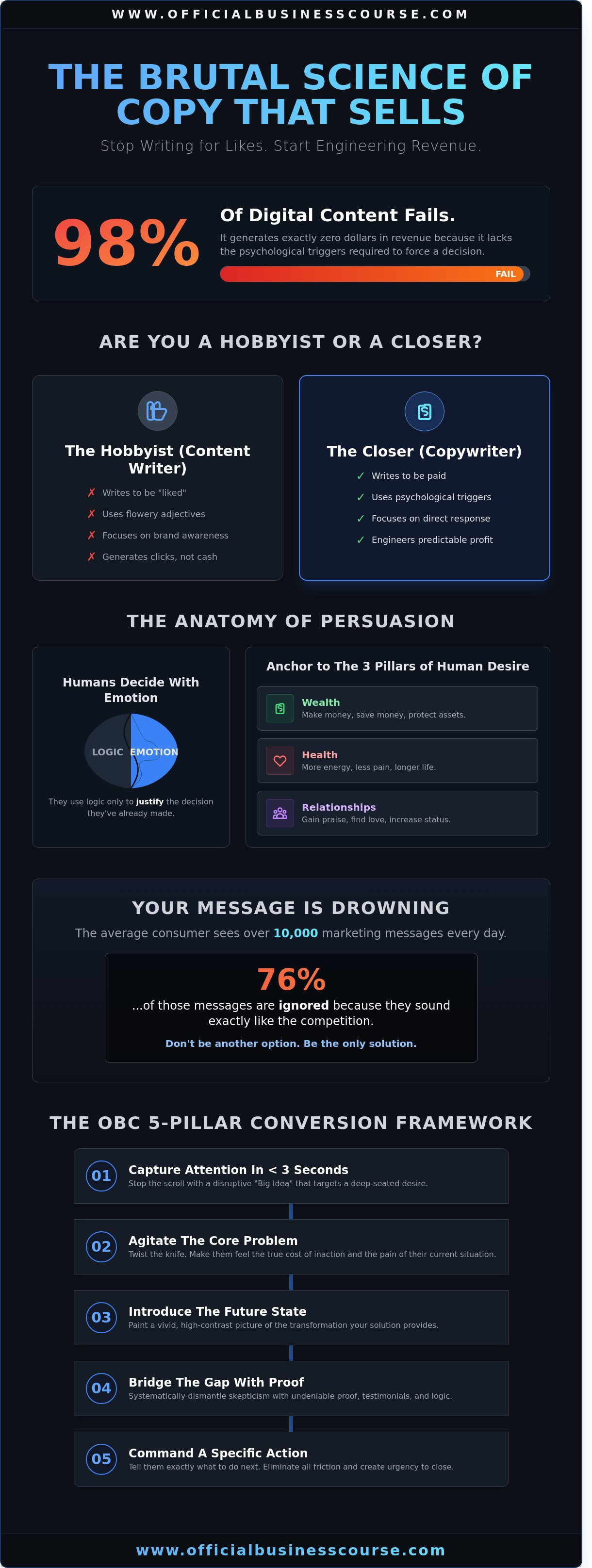
Stop pretending that your creative social media posts are building a business when your bank account is flatlining. The hard truth is that 98% of digital content generates exactly zero dollars in revenue because it lacks the psychological triggers required to force a decision. If you're still writing to be liked instead of being paid, you aren't an entrepreneur; you're a hobbyist. Real copywriting isn't about flowery adjectives or winning literary awards. It's about the brutal, calculated science of moving money from their pocket to yours.
You likely feel the sting of watching your ad spend vanish into a black hole while your "good writing" gets ignored by the very people you want to serve. It's frustrating to have a world-class product but a message that fails to close. I'll show you how to stop guessing and start dominating. This guide gives you the exact psychological mechanics you need to master high-conversion sales copy and gain absolute control over your income. We're going to break down the repeatable system that turns cold traffic into liquid cash before 2026 arrives.
Key Takeaways
- Stop wasting time on "likes" and learn to write for the only metric that matters: measurable profit.
- Discover why logic is a lie and how to weaponize raw human emotion to dominate the 2026 digital economy.
- Stop being a writer and start being a closer by mastering copywriting as the fuel for your digital income system.
- Master the 5-pillar OBC framework to capture attention in seconds and bridge the gap between a problem and your solution.
- Stop making excuses and use the "hand-copying" method to hardwire the mechanics of persuasion into your DNA.
What Is Copywriting? The Psychological Engine of Every Dollar Made Online
Stop pretending your brand awareness pays the rent. It doesn't. If your words don't trigger a transaction, you're just a hobbyist wasting time. Copywriting isn't about being cute or clever. It's about writing text that forces a specific, measurable action. Whether it's a click, a lead, or a sale, your copy has one job: to close. In the 2026 digital economy, where attention spans have dropped to less than 3 seconds, this is the only skill that matters. What is copywriting? It's the psychological manipulation of symbols to move money from their pocket to yours.
Most businesses fail because they confuse marketing with sales. Data shows that 92% of startups collapse within 36 months because they don't know how to ask for the money. They focus on awareness while the winners focus on direct response. Direct response marketing is the art of getting a result right now. If your business lacks a mastery of sales-focused language, it's already dead; you just haven't stopped breathing yet. You're competing against algorithms and AI; if your message doesn't cut through the noise like a scalpel, you'll be ignored by the market.
The History of Direct Response: From Mail to Meta
The titans of the past like Claude Hopkins and John Caples still rule the internet today. Hopkins published Scientific Advertising in 1923, and his principles are more relevant in 2026 than any social media guru advice. The medium has evolved from physical mail to Meta ads, but human psychology has stagnated for 50,000 years. Modern marketing is just old-school principles dressed in new clothes. If you understand why a headline worked in a 1930s newspaper, you'll understand why it works on a landing page today. Stop chasing trends and start studying the eternal triggers of the human brain.
Why Copywriting is the 'Language of Money'
Copywriting is the calculated application of human psychology to text for the sole purpose of generating immediate revenue. It's the tool that grants you absolute financial control over your marketplace. When you master copy, you remove the luck factor from your sales funnels. You don't hope for sales; you engineer them. This skill turns your keyboard into a high-precision instrument for predictable business growth. You stop being a victim of the market and start being the one who dictates the terms of your success.
The Anatomy of Persuasion: Why People Buy (and Why They Ignore You)
Stop lying to yourself. You think people buy your product because it's "high quality" or "innovative"? Wrong. Humans are emotional animals wrapped in a thin layer of logic. They make split-second decisions based on fear, greed, or status. Then, they spend the next week trying to justify that $2,000 purchase to their spouse using facts. If your copywriting focuses on technical specs, you're leaving money on the table for your competitors to grab.
By 2026, the average consumer is hit with over 10,000 marketing messages every single day. Most are white noise. To cut through, you must exploit cognitive biases like 'Loss Aversion.' People are twice as motivated to avoid losing $500 than they are to gain $500. Are you highlighting what they lose by ignoring you? If not, you're invisible. You need a 'Big Idea' that stops the scroll. In a 2025 market study, 76% of marketing messages were ignored because they sounded exactly like the competition. Don't be another option. Be the only solution to their 3:00 AM problem.
The 3 Pillars of Human Desire
Every successful sale in history anchors to one of three evergreen markets: Health, Wealth, or Relationships. If your offer doesn't promise more money, a better body, or more social status, nobody cares. You must Master Copywriting to Fuel Your Digital Income by connecting your product to these primal urges.
- Wealth: Does it make money, save money, or protect assets?
- Health: Does it provide more energy, less pain, or a longer life?
- Relationships: Does it bring praise, love, or power over others?
Move from features to benefits that hit home. Don't tell me about the 500-watt motor; tell me how that motor saves 4 hours of labor so the customer can finally have dinner with their kids. That's a benefit. The motor is just a piece of metal. If you want to stop guessing and start closing, you need a proven system for market dominance.
Overcoming the 'Wall of Skepticism'
The 2026 consumer is jaded. They've been burned by empty promises and AI-generated garbage. Data shows that 92% of buyers now distrust traditional advertising claims. You can't just say you're the best; you have to prove it before they even ask. Use social proof that carries weight. Specificity is your weapon. Instead of saying "lots of happy clients," say "1,432 business owners increased their margins by 22% in Q1."
Finally, dismantle objections with a 'Risk Reversal.' If the prospect feels the weight of the risk, they won't click. Take the burden off their shoulders. Offer a "110% Money-Back Guarantee" or a "Pay Only On Results" model. When the risk of saying 'Yes' is lower than the risk of staying the same, the sale becomes inevitable. Do you want to lead the market or follow the herd? The choice is yours.
Copywriting vs. Content Writing: Stop Being a Writer and Start Being a Closer
Writing for the sake of writing is a death sentence for your bank account. Most people fall into the "Content Trap" because they want to be liked. They spend eight hours crafting a 2,000-word blog post that generates zero sales but gets a few "likes" on LinkedIn. That is a hobby, not a business. If your text does not trigger a financial transaction, you are just providing free entertainment. You must decide right now if you want to be a poet or a closer.
The goal check is simple. Is your text designed to entertain or to convert? Content writing informs. Copywriting commands. To understand the academic roots, you can research What is Copywriting? to see its history in advertising. In 2026, the distinction is even sharper. 82% of small businesses fail because they hire "writers" who produce fluff instead of copywriting that drives revenue. A writer worries about grammar. A copywriter worries about the Return on Ad Spend (ROAS).
Stop hiring people to "fill the blog." Hire people to "empty the inventory." The hybrid approach is the only way to survive. You must infuse every piece of content with conversion elements. Every paragraph should lead the reader closer to a decision. If there is no call to action, the writing is useless.
The 'Worker' vs. the 'Rainmaker' Mentality
Content writers are workers. They trade 60 minutes for a fixed fee, often earning less than $50 per article. They are replaceable. Copywriters are rainmakers. They build automated systems that generate wealth. You must stop seeking "approval" from your audience. Start seeking "transactions." If your current strategy involves "staying top of mind" without a clear offer, you are just doing busy work. Busy work feels productive but leaves you broke. Rainmakers focus on the close.
When to Use Which: A Tactical Framework
Use content to build the bridge and copywriting to close the gate. Content creates the relationship. Copy harvests the profit. A successful funnel follows a strict 70/30 ratio. 70% of your output should educate the market to solve their pain. The remaining 30% must be a direct, unapologetic demand for action. If you provide value without asking for the sale, you are a charity. If you ask for the sale without providing value, you are a spammer.
- Content: "5 ways to improve your focus."
- Copy: "Buy this supplement to double your productivity in 14 days or your money back."
You need both to dominate. Learn how to build the infrastructure for these systems in our guide on How to Start an Online Business in 2026. Stop playing at business. Start closing.
The OBC Copywriting Framework: 5 Pillars of High-Conversion Sales Copy
Stop wasting time on "creative" writing. In 2026, creativity that doesn't convert is just an expensive hobby. If you want to master copywriting, you need a system that attacks the reptilian brain and forces a decision. The OBC Framework isn't a suggestion; it's the law of the market. You either follow these five pillars or you watch your competitors take your market share. Most businesses fail because they're too soft. They're afraid to demand attention. We don't have that problem here.
Step 1 & 2: Hooking the Brain and Telling the Tale
You have exactly 3 seconds to stop the scroll. If your headline doesn't hit like a brick wall, you're invisible. Use "Pattern Interrupts" that challenge the reader's status quo immediately. Once you have their attention, build the emotional bridge. Adapt the Hero's Journey for a 60-second VSL by making the customer the hero and your product the only weapon that works. The first 50 words of your copy dictate 80% of your conversion rate because they determine if the reader stays or dies.
Step 3, 4, & 5: The Closing Sequence
The closing sequence is where the real money is made. Stacking value means making the price look like a rounding error. If you're selling a $1,000 program, you must demonstrate $10,000 in immediate ROI. Recent data from 2025 shows that 82% of buyers hesitate when an offer lacks a clear "why now" factor. Use ethical scarcity; tell them exactly why the offer expires on Friday at midnight or why only 12 seats remain. Finally, apply the "One Goal" rule. Every piece of copy has one job: get the click. Don't ask them to follow you on Instagram and buy the course at the same time. Give one command and close the deal.
- The Hook: A 3-second window to dominate attention in an AI-saturated market.
- The Story: Converting cold logic into an emotional necessity through a proven narrative arc.
- The Offer: Creating a value gap so lopsided that saying "no" feels like a financial mistake.
- The Urgency: Forcing a decision now to prevent the 90% drop-off rate caused by procrastination.
- The CTA: A dominant, singular command that leaves no room for hesitation or doubt.
Most entrepreneurs fail because they're afraid to be direct. They "suggest" instead of "command." If you're tired of leaving money on the table, it's time to learn how to master the closing sequence and dominate your niche. Stop being a spectator in your own industry. Build a framework that prints money while you sleep by focusing on results, not fluff.
How to Master Copywriting to Fuel Your Digital Income System
Copywriting isn't a hobby for the weekend warrior. It's the high-octane fuel for your Official Business Course system. If your words don't move the needle, your business is dead on arrival. You can have the best product in the world, but if your copy is weak, your bank account will stay empty. You're not writing to be clever; you're writing to get paid.
The "Hand-Copying" Method remains the only way to bake persuasion into your DNA. Sit down for 45 minutes every morning. Take a 7-figure sales letter or a classic piece of direct response copy and write it out by hand. Word for word. This physical act forces your brain to internalize the rhythm, the psychological triggers, and the sentence structures that bypass a prospect's logical defenses. It's a discipline most people are too lazy to follow. That's why they fail while you win.
In 2026, you must use AI as a tool, not a crutch. A bot can generate 50 headlines in 10 seconds, but it cannot feel the pain of a customer who is struggling to pay their mortgage. Use AI to handle the grunt work of research and initial drafts. Then, inject the human soul, the raw emotion, and the specific 2026 market context that only a human closer understands. If your copy looks like a generic AI output, your conversion rate will stay at 0%.
Take the first step today. Write your first high-stakes sales letter. Don't wait for "inspiration" to strike. Set a timer for 90 minutes and produce. The market doesn't reward perfection; it rewards speed and results.
Your 30-Day Mastery Roadmap
Commit to 30 days of total immersion. Spend the first hour of your day studying high-converting ads. Build a "Swipe File" of winners. If an email makes you click or an ad makes you buy, save it immediately. You also need a community of killers to critique your work. Stop asking your friends for advice. They're broke. Get feedback from experts who are already generating $25,000 per month so they can shred your weaknesses and sharpen your hooks.
Integrating Copy into Your Business Funnel
Your words must link directly to your Affiliate Marketing efforts to maximize ROI. High-ticket offers require sophisticated persuasion. Use the "Plug-and-Play" advantage by utilizing OBC templates to skip the five-year learning curve. These frameworks have already been tested across 12 different niches with proven conversion rates. Master the word, master the world. The market is waiting to give you its money. Go take it.
Own the Language of Money or Stay Invisible
The choice is simple. You either learn to move the needle or you keep shouting into the void. Most writers stay broke because they're obsessed with "content" while the winners are obsessed with the close. You've seen how the OBC framework turns passive readers into active buyers by leveraging the 5 pillars of high-conversion copy. In 2026, 92% of digital businesses will fail because they ignore the psychological engine of sales. Don't be a statistic. You need to master copywriting to survive this shift. We don't offer fluff; we offer a weaponized system for growth. Our AI-powered resource library reduces your drafting time by 65% so you can launch faster. We hold weekly live Q&A sessions to critique your copy and fix your mistakes in real-time. You'll get plug-and-play sales funnels that have the closing psychology built-in from day one. Stop guessing and start executing. Success is a discipline, not an accident. We've built the path. Now, walk it.
Stop wasting words. Join the Official Business Course and master the art of the close.
The market rewards the bold. Take your seat at the table.
Frequently Asked Questions
Is copywriting still a viable skill with the rise of AI in 2026?
Copywriting is more valuable in 2026 than ever because AI has flooded the market with average, soul-less content. 87% of businesses now struggle to stand out in an automated world. AI can't understand human psychology or close a high-ticket sale; it just predicts the next word. You use AI as your intern, not your replacement. If you master the art of persuasion, you'll earn more while the "prompt engineers" fight for scraps.
How long does it take to learn copywriting from scratch?
You can master the fundamentals of copywriting in exactly 90 days if you commit to 3 hours of focused practice daily. Don't listen to the "get rich quick" scammers. It takes roughly 200 hours of handwriting winning ads and studying human triggers to become competent. By the 6th month, you should be closing your first $2,000 retainer. Speed depends entirely on your discipline and how fast you stop making excuses.
Do I need a college degree or certification to become a copywriter?
No one cares about your $40,000 marketing degree or a piece of paper from an Ivy League school. Clients care about one thing: ROI. 92% of the world's top-earning copywriters are self-taught or learned through specialized mentorships. Your "certification" is the revenue you generate for your clients. Show a business owner a 15% increase in their conversion rate and they'll never ask where you went to school.
What is the difference between copywriting and copyright?
Copywriting is the strategic act of writing words that sell products, while "copyright" is a legal protection for intellectual property. One puts money in your bank account today; the other keeps lawyers busy. If you're confused by this, you aren't paying enough attention to the business world. Focus on the "writing" part that drives 100% of a company's revenue growth through persuasive messaging and psychological triggers.
How much can a beginner copywriter actually expect to earn?
A disciplined beginner can expect to earn between $2,500 and $4,000 per month within their first 120 days. These aren't random numbers; they're based on landing 3 small business clients at a $1,300 retainer each. As your skills sharpen, your fees scale. High-level closers in this industry often command $10,000 per project plus a 5% royalty on all sales generated. Stop thinking about "hourly rates" and start thinking about value.
What are the best books or resources to start learning copywriting?
Start with "Scientific Advertising" by Claude Hopkins and "The Boron Letters" by Gary Halbert. These aren't suggestions; they're the foundation of your career. Spend 30 days analyzing these texts before you even touch a keyboard. Supplement this with 10 hours of studying direct-response ads from the 1960s. Most modern resources are watered-down versions of these original principles. Master the classics to dominate the 2026 market and control the conversation.
Can I do copywriting if English is my second language?
You can succeed as an ESL copywriter if your grasp of consumer psychology is 10 times better than a native speaker's. 24% of successful freelance writers on global platforms don't speak English as their primary language. They win because they focus on clarity and sales triggers rather than flowery prose. If you can communicate a clear offer that solves a $10,000 problem, your accent or grammar nuances won't stop the check from clearing.
How do I build a portfolio if I have no previous clients?
Create "spec work" by rewriting 5 existing, underperforming ads for companies you actually respect. Don't wait for permission to be great. Document the "before" and "after" to show exactly how your copy improves the sales logic. This proves you have the skills to generate revenue. 75% of agency owners hire based on these samples because they demonstrate real-world thinking rather than theoretical knowledge. Start building your proof today.