
Ninety percent of business podcasts are nothing more than expensive, time-consuming hobbies that fail before reaching episode seven. Don't join the ranks of the digital noise makers who talk to empty rooms while their bank accounts remain stagnant. You've seen the data showing that monthly podcast listeners grew by 12% in the last year, yet you're still overcomplicating how to start a podcast because you're afraid of looking like an amateur.
It's a valid concern; wasting hundreds of hours on a project that doesn't drive revenue is a business failure. You want authority. You want control. But the technical overwhelm is keeping you passive. I'm going to show you how to build a high-leverage sales machine rather than a weekend distraction. This guide ensures you command absolute market dominance and force your niche to pay attention.
We're stripping away the fluff to focus on a 3-step system for professional distribution on Spotify and Apple, combined with a lead generation framework that turns listeners into high-ticket clients. Stop talking and start closing.
Key Takeaways
- Bridge the "Authority Gap" and ensure your show survives the "Podfading" trap that kills 90% of amateur creators.
- Stop following "passion" into bankruptcy and use the Unfair Advantage audit to validate a niche that generates actual revenue.
- Learn how to start a podcast with a no-excuses tech stack that prioritizes acoustic dominance over overpriced, flashy equipment.
- Execute a high-leverage launch using a 5-step blueprint designed to prevent burnout and command immediate market attention.
- Move listeners off third-party platforms and into your sales funnel to turn audio content into a predictable revenue stream.
The Authority Gap: Why Most Podcasts Fail (and How to Dominate)
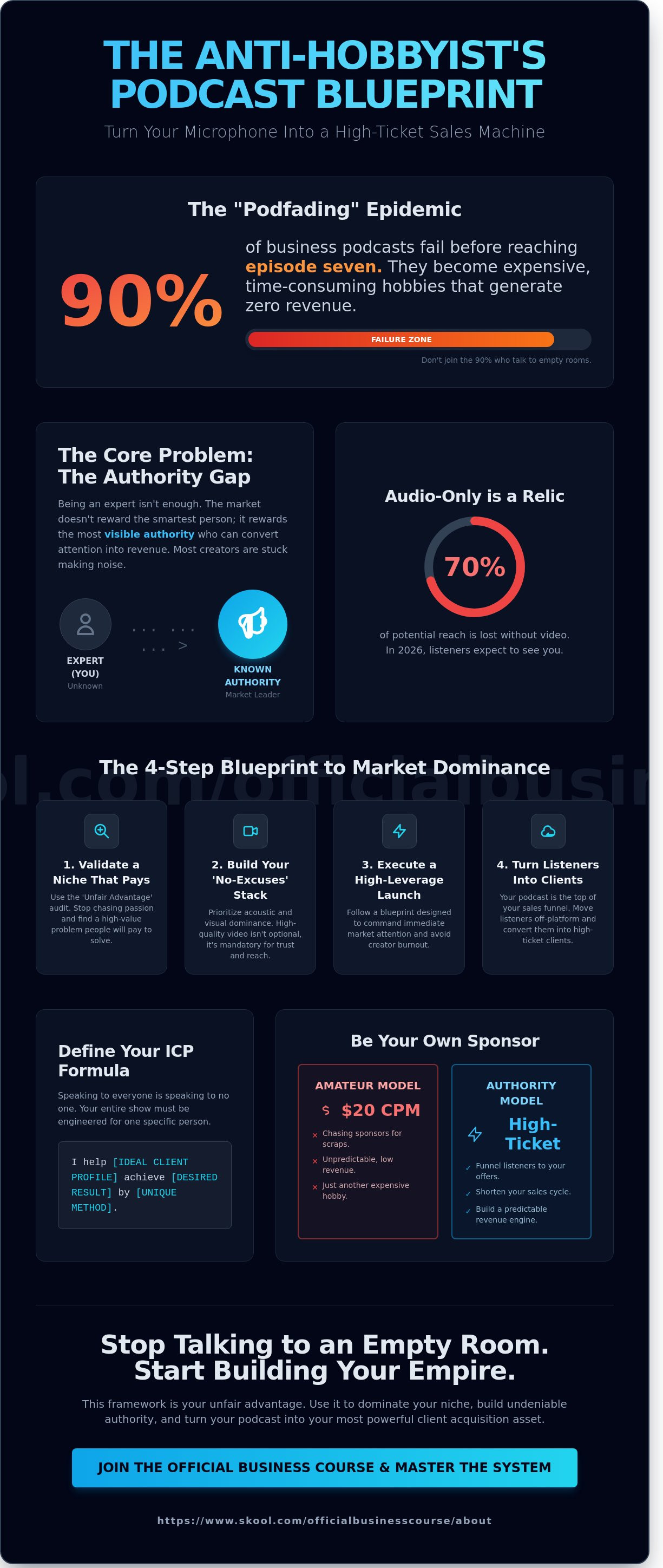
Most people who want to learn how to start a podcast will fail before they even hit double digits. It's a 90 percent failure rate. The industry calls it "Podfading." Most creators quit by episode seven because they realize talking into a microphone isn't a business strategy. They mistake a hobby for an authority play. If you're looking for a participation trophy, stop reading now. This is about domination and market control.
You probably think your expertise is enough. It isn't. There's a massive Authority Gap between being an expert and being known. You might be the best in your niche, but if your audience is zero, your revenue is zero. In 2026, the history of podcasting proves that the market doesn't reward the smartest person; it rewards the most visible person who can actually close. Stop broadcasting and start using your show as a top-of-funnel asset designed to drive leads. Out of the 4.2 million shows currently listed, less than 18 percent are active. Most people are just making noise. You're here to make money.
Audio-only is a relic. If you aren't capturing high-quality video and distributing it across every social channel, you're invisible. You're leaving 70 percent of your potential reach on the table. In 2026, listeners expect to see your face. They want to see the conviction in your eyes when you talk about your results. This is how to start a podcast that actually builds a legacy rather than just a library of ignored files.
The Myth of the 'Radio Voice'
Stop worrying about how your voice sounds. Authenticity wins in 2026. Polished, over-produced corporate drivel is ignored by the modern consumer. People listen for the "Bartender Effect." They want a connection, not a perfect frequency response. They want a leader they can trust. Vocal Authority is the combination of conviction and clarity. If you don't believe what you're saying, why should they?
Podcasting as a Revenue Engine
Forget about sponsors. Chasing a 20 dollar CPM is for amateurs who don't understand math. You need to be your own sponsor. Your show exists to shorten the sales cycle for your high-ticket offers or consulting services. It builds trust while you sleep. However, you must have an online business established before you open your mouth. A podcast without a backend is just a very expensive therapy session. Use your episodes to move people from "listener" to "client" in record time.
The Niche Validation Framework: Choosing a Topic That Pays
Most entrepreneurs treat their podcast like a hobby. That is why they are broke. If you want to know how to start a podcast that actually generates revenue, you must stop following your passion. Passion is for the weekends. Profit is for the 1% who dominate. In 2026, over 4.5 million podcasts exist. If you enter a crowded market without a financial strategy, you are committing suicide by content. You don't need a "nice" topic. You need a gap in the market that people are willing to pay to close.
Use the OBC 'Unfair Advantage' audit. Ask yourself: What high-value problem have I solved 100 times? If you cannot answer that, you have no business behind a microphone. Analyze the top 1% of your niche. They are often too polished, too corporate, or too slow. Find the 'unspoken' gaps they are afraid to touch. That is where the money is. Validate your idea with hard numbers. Use tools to check search volume and social sentiment. If no one is searching for your solution, change the solution. Forbes suggests a step-by-step approach to ensure your business goals align with your content strategy before you record a single word.
Defining Your Ideal Listener (The ICP)
Speaking to everyone is the fastest way to be heard by no one. Your Ideal Customer Profile (ICP) is a single person. They have a specific pain, a specific desire, and a specific bank balance. If you don't know their top three frustrations at 2:00 AM, you're just talking to yourself. Create a Listener Avatar that focuses on the one problem you solve for them. Your one-sentence pitch must be: "I help [ICP] achieve [Result] by [Unique Method]." If they don't hit subscribe immediately, your pitch is weak. If you want to master the art of high-ticket authority, join the Official Business Course community today.
Naming and Branding for Dominance
Stop trying to be clever. Clever doesn't show up in search results. Your title needs to be searchable, not just a pun that only you understand. If you teach sales closing, put "Sales Closing" in the title. Your artwork must stop the scroll on a 6 inch mobile screen. Use high-contrast, minimalist design principles. Your description bio shouldn't tell them what the show is about. It should tell them who they will become. Sell the transformation, not the audio file. Learning how to start a podcast is easy; building an authority brand that commands high-ticket fees is where the real work begins.
- SEO First: Use keywords in your title and episode headers.
- Visual Authority: Your face or a bold icon should dominate the cover art.
- The Hook: Your first 30 words in the bio must address the listener's biggest pain point.
The 'No-Excuses' Tech Stack: Gear and Software for 2026
Stop hiding behind gear reviews. Most entrepreneurs use "researching equipment" as a sophisticated way to procrastinate. Your audience wants your authority; they don't care about your frequency response curve. If you want to know how to start a podcast that actually generates revenue, you need a setup that stays out of your way. Equipment is a tool, not a strategy.
Success follows a simple hierarchy. The 'Starter' tier is a $150 USB microphone. The 'Pro' tier moves to an XLR setup like the Shure SM7B. The 'Dominator' tier is a dedicated, sound-treated studio. Start where you are, but start today. A $500 microphone won't save you if your room sounds like a bathroom. 85% of your audio quality comes from your environment, not your hardware. Record in a space with soft surfaces. Use rugs, curtains, or even a walk-in closet. Control the echoes or lose the listener.
The brutal truth: if you spend more than 120 minutes editing an episode, you're failing as a business owner. Your time is your most expensive asset. If you're clicking through audio waveforms for three hours, you aren't building an empire; you're playing with a hobby. Use the tech to buy back your life. Focus on the message, not the millisecond.
Hardware: The Bare Essentials
USB microphones offer simplicity. XLR setups offer longevity. Choose speed over perfection every time. Headphones are non-negotiable. You must hear the background hiss before your audience does. In 2026, video is the standard. Over 70% of listeners now consume podcasts on video-centric platforms. Invest in a 4K mirrorless camera or a high-end webcam. If they can't see your conviction, they won't buy your solution. Lighting matters more than the lens. Use a simple three-point light setup to look like a professional, not a basement dweller.
AI-Powered Workflow Automation
Stop acting like a sound engineer. Modern entrepreneurs use AI to handle the "grunt work." Tools like Descript allow you to edit audio by deleting text. AI-leveling software replaces the need for a professional mixer. Use automation to turn a 30-minute recording into show notes, emails, and 10 social media clips instantly. When you learn how to start a podcast with an automated workflow, you focus on the only thing that matters: the closing. Outsource the technical noise to the machines. Your voice is the only part that isn't replaceable. Efficiency is the only way to scale without burning out.
The 5-Step Launch Blueprint: From Zero to Published
Stop overthinking the technicalities. Most beginners fail because they lack a system, not because they lack a microphone. If you want to learn how to start a podcast that actually generates revenue, you need a blueprint that prioritizes momentum over perfection. You are either building an asset or wasting your time. Choose now.
Batch your first five episodes before you hit publish. This is your safety net. Data from 2025 industry reports shows that 70 percent of new shows "podfade" before reaching episode seven. Batching ensures you stay ahead of the calendar. It gives you the control required to maintain a professional schedule. Without five episodes in the chamber, you are one bad week away from total failure.
Your "Trailer" episode is your 2-minute manifesto. It is not a polite introduction. It is a declaration of who you are and why the listener should care. Seed this to the directories 14 days before your official launch. This period allows Apple Podcasts and Spotify to verify your RSS feed. It ensures your show is live and searchable the moment you drop your first full episode.
Recording Your First Masterpiece
Use the "Hook-Meat-Payoff" script structure. You have exactly 15 seconds to grab a listener before they bounce. State the problem, promise the solution, and deliver the meat. When interviewing, stop being polite. Ask the questions your competitors are afraid of. If you aren't making your guest think, you aren't providing value. Place your Call to Action (CTA) at the 15-minute mark when engagement is at its peak. Do not wait until the end. Most listeners leave before the closing music starts.
Directories and Distribution
Your RSS feed is the heartbeat of your show. It is where your podcast lives; the directories are just windows. You must submit your feed to the "Big Three": Apple Podcasts, Spotify, and YouTube. As of January 2026, YouTube requires full RSS ingestion for any show to be properly indexed in their podcast vertical. Ignore this and you lose 30 percent of your potential reach instantly.
Show notes are not an afterthought. They are your primary tool for SEO and lead capture. Every episode needs 300 words of context, timestamped highlights, and direct links to your offers. This is how you turn a passive listener into a paying client. Finally, execute a "Big Bang" launch. Coordinate your network to provide 25 reviews within the first 48 hours. This volume triggers the algorithms and pushes you up the charts.
Stop playing small with your business reach and start dominating your niche today.
Join the Official Business Course and master the art of authority.Turning Listeners into Leads: The OBC Authority System
Most people fail at podcasting because they treat their show like a radio station. You aren't here to entertain the masses for free. You're here to build an empire. If you're learning how to start a podcast, you must understand the "Podcast-to-Funnel" pipeline from day one. You don't want "fans"; you want clients. Your show is the top of the funnel. It's the bridge that moves a stranger from their car or the gym directly to your checkout page.
You don't own your audience on Spotify or Apple. They do. If they change an algorithm or delete your account, your business vanishes. You must own the data. Every episode needs a clear "exit ramp" that leads to an email list. Forget generic newsletters. Offer a lead magnet that solves a specific, high-value problem. Give them a checklist, a private training, or a proprietary calculator. Once they're on your list, they belong to your Official Business Course ecosystem. This is where interest turns into revenue.
Monetization Without Selling Out
Stop chasing sponsors. The math of wealth doesn't favor $25 CPM ad spots. To make $5,000, you'd need 200,000 downloads. That's a waste of time. Sell high-ticket coaching or digital products instead. One $5,000 sale beats 200,000 listeners every single time. You can also use your show as a "Trojan Horse" for affiliate marketing. Recommend the tools you actually use to run your business. Don't be a shill; be a curator. Use interviews to network. An interview with a high-value prospect is better than any cold call. It's consultative selling disguised as content.
Scaling Your Digital Empire
Efficiency is the only way to survive. One 45-minute recording should generate 20 pieces of social media content. Chop it into Reels, turn the transcript into a blog post, and use the key insights for Twitter threads. This creates an omnipresent brand without you living in a recording booth. Build a community around the show using platforms like Skool. This turns passive listeners into active participants who pay for access.
- Repurpose everything: One episode is a month of content.
- Community focus: Move listeners to a space you control.
- Direct calls to action: Tell them exactly what to buy next.
Stop over-analyzing how to start a podcast and hit the record button. Industry data shows that 90% of podcasts fail before episode ten because the creators are weak. Don't be one of them. The market doesn't wait for the "ready". It rewards the fast. Get your microphone, open your mouth, and start closing.
Stop Recording and Start Dominating
Most creators fail because they treat their voice like a hobby. Industry data shows that 90% of new shows never make it past episode 10. You have the niche validation framework. You have the 2026 tech stack. You even have the 5-step blueprint to launch. But knowledge without execution is just expensive noise. Learning how to start a podcast is only the entry fee. The 2026 market doesn't reward participation. It rewards those who convert attention into revenue through a disciplined authority system. Stop guessing. Control your results.
We provide the weekly live Q&A sessions with Eric Smith to sharpen your strategy. You get our plug-and-play sales funnels to capture every lead. You join a private community of high-level entrepreneurs who don't accept excuses. Don't waste another year on tactics that don't scale. Your audience is waiting for a leader. It's time to take your place at the top. You've got the tools. Now use them.
Ready to turn your voice into a revenue machine? Join the Official Business Course today.
Frequently Asked Questions
Do I need an expensive studio to start a podcast in 2026?
No, you don't need a professional studio to dominate your niche this year. High-quality audio comes from a $100 dynamic microphone and a room with zero echo. Spend your budget on a Shure MV7X and basic acoustic panels instead of rent. 95% of your listeners won't know the difference between a bedroom and a glass-walled office. Focus on the value you deliver, not the furniture in your room.
How much does it actually cost to start a podcast from scratch?
You can start for exactly $0 if you have a phone, but $250 is the sweet spot for professional results. Buy a Samson Q2U for $70 and use free hosting like Spotify for Podcasters to get moving. This small investment removes the amateur sound that kills your authority immediately. Stop overcomplicating the math and learn how to start a podcast with the basics. Every day you wait is a day of lost revenue.
How do I get my podcast on Spotify and Apple Podcasts?
You distribute your show by submitting an RSS feed from a hosting platform like Buzzsprout or Libsyn. These platforms push your content to Spotify and Apple Podcasts automatically once you hit publish. It takes 48 hours for Apple to approve your first episode. This is a one-time setup that requires zero technical skill. If you can't handle this five-minute task, you aren't ready to lead an industry.
Can I start a podcast with just my iPhone?
You can start with an iPhone today to prove you actually have something worth saying. The 2026 standard for content is authenticity over polish, but don't stay on a phone for more than 5 episodes. Use the built-in microphone to record your first pilot and upload it. If you can't stay consistent for 30 days with the tools in your pocket, an expensive setup won't save your business.
How long should a podcast episode be for maximum engagement?
The ideal length for a podcast episode is 22 to 38 minutes to match the average listener's commute. Stop filling airtime with useless fluff and get to the point. If you can't deliver a breakthrough in 30 minutes, you're wasting everyone's time. Data shows that completion rates drop by 40% once an episode crosses the one-hour mark. Be brief, be bold, and be gone so your audience can take action.
How do I find guests for my podcast if I have no following?
Find guests by offering them access to your specific target market, even if that market is currently small. Don't ask for favors; offer a platform for their message. Send 5 personalized pitches every day using a clear three-sentence structure. Experts care about the quality of the conversation, not just the download numbers. 15% of high-level CEOs will say yes if your pitch shows you've actually done your homework.
What is the best way to monetize a small podcast audience?
The fastest way to monetize is to sell your own high-ticket services directly to your listeners. Don't wait for 10,000 downloads to get a $20 sponsorship deal that pays nothing. If you have 100 listeners and a $2,000 offer, you only need one conversion to win. This is how to start a podcast that actually funds your lifestyle. Control the offer, control the lead, and you'll control the profit.
How often should I publish new podcast episodes?
Publish one high-quality episode every week on the same day without exception. Consistency builds a psychological contract with your audience that you cannot afford to break. 80% of new podcasts disappear before episode 10 because the creators lack discipline. Pick a day, set a deadline, and hit it. If you can't commit to 52 episodes a year, don't waste your time starting something you won't finish.